
Tokenization
Tokenization is the process of splitting text into units that a language model can process. These units are called tokens, and they are not the same as words.
Suggested duration: 30 minutes
Learning goals
By the end of this notebook, you should be able to:
explain what tokenization is and why LLMs need it
relate tokens to cost, context length, and latency
distinguish common tokenization strategies at a high level
inspect how different kinds of text are split into tokens
recognize why tokenization affects multilingual and code-heavy workflows
Table of Contents
What is tokenization?
Mini demos
What is tokenization?
LLMs do not read raw text directly. They convert text into tokens first.
A token may be:
a full word
part of a word
punctuation
whitespace patterns
pieces of code
Because of this, 100 words is not always 100 tokens. English, Spanish, code, equations, and emoji can all tokenize differently.
Why it matters
Tokenization matters because it affects:
cost: many APIs charge per token
context window usage: long inputs may exceed model limits
latency: more tokens usually means slower responses
multilingual performance: some languages break into more pieces
formatting quality: code and tables can be token-heavy
a simple approach to solve:classification and recommendations problems
Common tokenization strategies
High-level families include:
word-based tokenization: simple but poor for unseen words
subword tokenization: breaks rare words into reusable pieces
byte-level tokenization: robust across many scripts and symbols
Modern LLMs often rely on subword or byte-level approaches because they balance vocabulary size and coverage.
Tools and visualizations
[2]:
from transformers import AutoTokenizer

text = "Ocean temperature anomalies in 2025 were higher than expected."

# Compare how several pretrained tokenizers split the same text.
model_names = [
    "bert-base-uncased",
    "roberta-base",
    "gpt2",
    "xlm-roberta-base",
]

print("Original text:", text)
print()

for model_name in model_names:
    tokenizer = AutoTokenizer.from_pretrained(model_name)
    tokens = tokenizer.tokenize(text)
    token_ids = tokenizer.convert_tokens_to_ids(tokens)

    print(f"Model: {model_name}")
    print("Tokens:", tokens)
    print("Token IDs:", token_ids)
    print("Count:", len(tokens))
    print("-" * 70)
/Users/isaac/Projects/AppOC/.venv/lib/python3.12/site-packages/tqdm/auto.py:21: TqdmWarning: IProgress not found. Please update jupyter and ipywidgets. See https://ipywidgets.readthedocs.io/en/stable/user_install.html
  from .autonotebook import tqdm as notebook_tqdm
Original text: Ocean temperature anomalies in 2025 were higher than expected.

Warning: You are sending unauthenticated requests to the HF Hub. Please set a HF_TOKEN to enable higher rate limits and faster downloads.
Model: bert-base-uncased
Tokens: ['ocean', 'temperature', 'an', '##oma', '##lies', 'in', '202', '##5', 'were', 'higher', 'than', 'expected', '.']
Token IDs: [4153, 4860, 2019, 9626, 11983, 1999, 16798, 2629, 2020, 3020, 2084, 3517, 1012]
Count: 13
----------------------------------------------------------------------
Model: roberta-base
Tokens: ['Ocean', 'Ġtemperature', 'Ġanomalies', 'Ġin', 'Ġ2025', 'Ġwere', 'Ġhigher', 'Ġthan', 'Ġexpected', '.']
Token IDs: [41496, 5181, 36071, 11, 10380, 58, 723, 87, 421, 4]
Count: 10
----------------------------------------------------------------------
Model: gpt2
Tokens: ['Ocean', 'Ġtemperature', 'Ġanomalies', 'Ġin', 'Ġ2025', 'Ġwere', 'Ġhigher', 'Ġthan', 'Ġexpected', '.']
Token IDs: [46607, 5951, 35907, 287, 32190, 547, 2440, 621, 2938, 13]
Count: 10
----------------------------------------------------------------------
Model: xlm-roberta-base
Tokens: ['▁Ocean', '▁temperature', '▁anomali', 'es', '▁in', '▁2025', '▁were', '▁higher', '▁than', '▁expected', '.']
Token IDs: [55609, 52768, 190312, 90, 23, 76924, 3542, 77546, 3501, 84751, 5]
Count: 11
----------------------------------------------------------------------
Demo
First, with 3 and, after 4 sentences!
[6]:
import numpy as np
import matplotlib.pyplot as plt

from sklearn.decomposition import PCA
from transformers import AutoModel, AutoTokenizer

sentences = [
    "Marine climatology shows persistent warm sea-surface temperature anomalies in the eastern Atlantic.",
    "Ocean heat content and salinity gradients indicate a stronger upper-layer stratification this season.",
    "Soil temperature over inland agricultural areas rises faster during dry spells and low moisture conditions.",
    # "The use of chemicals in food industry is a global issue in health."
]
labels = [
    "Marine climate 1",
    "Marine climate 2",
    "Soil temperature",
    # "Chemicals in food"
]

model_name = "sentence-transformers/all-MiniLM-L6-v2"
tokenizer = AutoTokenizer.from_pretrained(model_name)
model = AutoModel.from_pretrained(model_name)

encoded = tokenizer(sentences, padding=True, truncation=True, return_tensors="pt")
with __import__("torch").no_grad():
    outputs = model(**encoded)

# Mean pooling with attention mask to get one embedding per sentence.
attention_mask = encoded["attention_mask"].unsqueeze(-1)
masked = outputs.last_hidden_state * attention_mask
sentence_embeddings = masked.sum(dim=1) / attention_mask.sum(dim=1)
X = sentence_embeddings.detach().cpu().numpy()

# If embedding dim is high, reduce first to 3 principal components.
pca3 = PCA(n_components=3)
X3 = pca3.fit_transform(X)

# 2D projection (PC1 vs PC2)
plt.figure(figsize=(8, 6))
for i, label in enumerate(labels):
    plt.scatter(X3[i, 0], X3[i, 1], s=120)
    plt.text(X3[i, 0] + 0.01, X3[i, 1] + 0.01, label, fontsize=10)

plt.title("Sentence Embeddings Projected to 2D (PC1 vs PC2)")
plt.xlabel("PC1")
plt.ylabel("PC2")
plt.grid(alpha=0.3)
plt.show()

# 3D projection (PC1, PC2, PC3)
fig = plt.figure(figsize=(9, 7))
ax = fig.add_subplot(111, projection="3d")
for i, label in enumerate(labels):
    ax.scatter(X3[i, 0], X3[i, 1], X3[i, 2], s=120)
    ax.text(X3[i, 0], X3[i, 1], X3[i, 2], label, fontsize=9)

ax.set_title("Sentence Embeddings Projected to 3D (PC1, PC2, PC3)")
ax.set_xlabel("PC1")
ax.set_ylabel("PC2")
ax.set_zlabel("PC3")
plt.show()

print("Explained variance ratio (PC1, PC2, PC3):", pca3.explained_variance_ratio_)
Loading weights: 100%|██████████| 103/103 [00:00<00:00, 18415.67it/s]
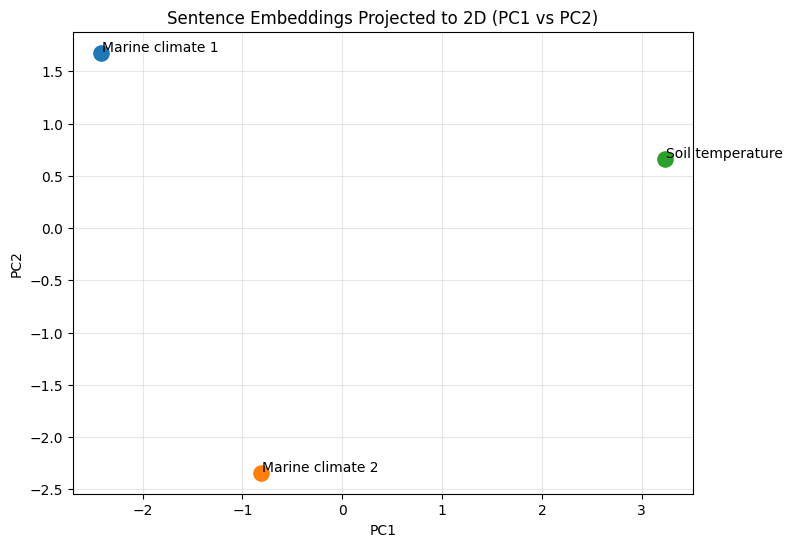
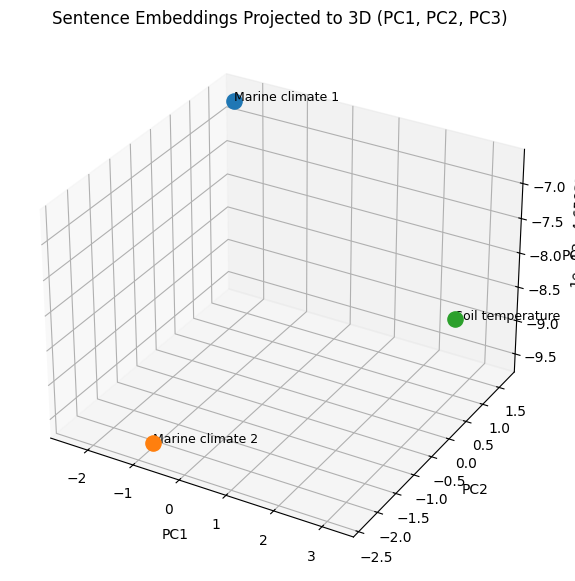
Explained variance ratio (PC1, PC2, PC3): [6.5944564e-01 3.4055436e-01 2.5364978e-14]
Activity
Do the same with the following terms:
[ ]:
examples = [
    "chlorophyll",
    "Brandon Sanderson",
    "sea_surface_temperature",
    "flowers and plants in the field",
    "CO2",
    "The ways of kings",
    "Guerra de los Cien Años"
]